
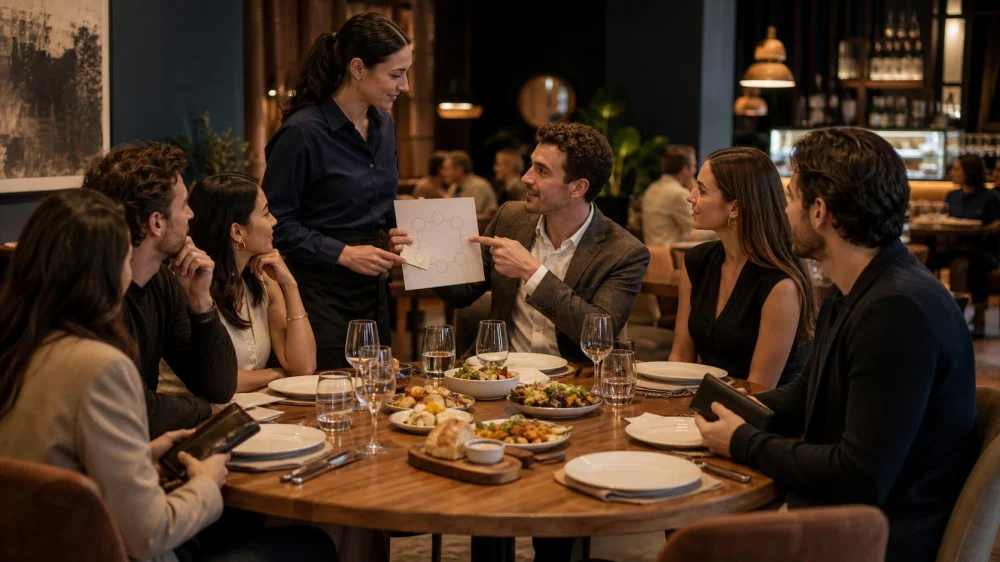
How to Ask About Split Checks Before a Group Meal
On this page
- Quick answer
- Ask for the actual policy
- Choose a bill structure before ordering
- Assign shared food and drinks clearly
- Track tax, service charges, and tips
- Coordinate payment methods
- Resolve errors without delaying the room
- Group-bill checklist
- Limitations and courtesy notes
- Frequently asked questions
- Choose one bill organizer
Quick answer
Before the group orders, ask whether the restaurant can create separate checks, how many it allows, whether it splits by seat, item, couple, or equal share, and whether large-party service charges or card limits apply. Tell the server the chosen structure immediately and keep seats stable. Decide how shared dishes, bottles, birthday items, discounts, tax, service charges, and additional tips will be allocated.
A payment app can settle the group afterward, but the restaurant still needs one clear instruction for its own bill.

Ask for the actual policy
Do not assume “split checks available” means unlimited cards or any allocation. Ask while booking for a large group, then reconfirm at the table. Policies may differ by party size, event menu, private room, peak period, reservation platform, or point-of-sale system.
Clarify whether each check must meet a minimum, whether one person guarantees the reservation, and whether the restaurant can print separate itemized receipts for business reimbursement.
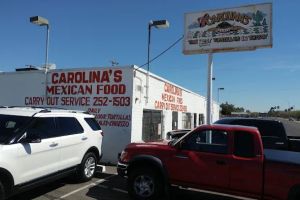
The Original Carolina's Mexican Food
1202 E Mohave St, Phoenix, AZ 85034, USA
Choose a bill structure before ordering
The simplest options are one check, equal division, checks by seat or household, or one payer with private reimbursements. Item-by-item division is more complex, especially when people move seats or share courses.
Choose one method the restaurant accepts and explain it once. If checks follow seat numbers, keep seats and orders consistent. Tell the server when a child, guest of honor, or host should be grouped with another payer.
Assign shared food and drinks clearly
Before ordering a shared plate, decide whether it belongs to the host, is divided equally, or is shared by named diners. The same applies to bottles, pitchers, corkage, cake fees, tasting supplements, and communal appetizers.
Respect diners who did not consume alcohol, premium items, or a particular dish. Equal splitting is convenient only when the group agrees it is fair. Do not force an abstaining or allergy-restricted guest to subsidize items they could not share.
Track tax, service charges, and tips
Read the menu and reservation terms for large-party gratuity, service charge, administrative fee, room fee, minimum spend, cancellation charge, and tax. Ask what a listed fee is and whether any amount goes to service staff rather than guessing.
When checks are separated, confirm how fees and discounts are distributed. Review whether an additional tip line appears and decide based on the bill, local practices, and the restaurant's explanation.
Coordinate payment methods
Ask how many cards the restaurant accepts and whether cash, contactless payment, gift cards, or digital wallets are supported. Have cards ready and tell the server the amount or check each card covers. Avoid handing over an unlabeled pile.
For one payer, use a shared note or calculator to record each person's items and proportional fees. Send private payment requests after leaving rather than making the server wait while everyone downloads an app.
Resolve errors without delaying the room
Review checks before cards are processed. Point to the specific item, seat, quantity, or fee that appears wrong. One spokesperson should coordinate corrections with the server while the rest of the group stays available.
After payment, keep receipts and resolve duplicate or incorrect card charges promptly through the restaurant. Do not post card details or an employee's personal information publicly.
Group-bill checklist
- Ask about split-check and card limits before ordering.
- Choose one accepted bill structure.
- Keep seat numbers and households consistent.
- Assign shared plates, drinks, and fees.
- Check service charges and tip lines.
- Prepare payment methods before checks arrive.
- Review itemization before processing.
- Keep receipts for corrections or reimbursement.
Limitations and courtesy notes
- Restaurant policies and local fee-disclosure rules vary.
- This guide is not tax, employment, or legal advice.
- Do not pressure staff to override a stated policy at closing time or during a rush.
- Protect card numbers, receipts, and reimbursement details.
Frequently asked questions
When should we ask for separate checks?
During booking for a large group and again before ordering.
Can a restaurant refuse multiple cards?
Payment and split policies vary; ask in advance and use a private reimbursement plan if necessary.
How should a shared bottle be divided?
Assign it to named drinkers, split it among those who agree, or let a host cover it.
Is a service charge the same as a tip?
Not necessarily. Ask the restaurant what the charge represents and how it is handled.
What if one person leaves early?
Have them settle their accepted check structure before leaving or arrange a clearly recorded payer.
Choose one bill organizer
Before the meal, ask one guest to confirm the restaurant's policy and tell the group whether the plan is by seat, household, equal share, or one payer. Send that plan with the reservation time.



 LongHorn Steakhouse4.0 (3579 reviews)
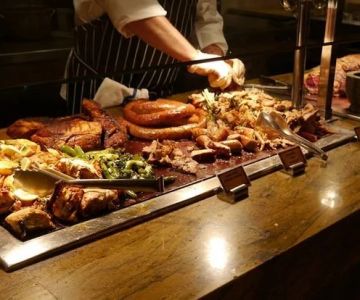
 Red Wok Buffet4.0 (3288 reviews)
 Burger King3.0 (441 reviews)
 El Rincon Casero0.0 (0 reviews)
 Pizzeria Bianco4.0 (2384 reviews)
 Dona licha mexican kitchen3.0 (368 reviews)
 Unique Outdoor Dining Spots Across America You Should Visit
 25 Amazing Street Food-Inspired Restaurant Dishes in the United States
 The Best Street Food Markets in New York City for a Culinary Adventure
 How to Choose a Restaurant for a Business Meal
 Don’t Miss These Hidden Gems in San Francisco | Restaurants Explorer
 Most Instagrammable Restaurants in the US for Food and Photos