
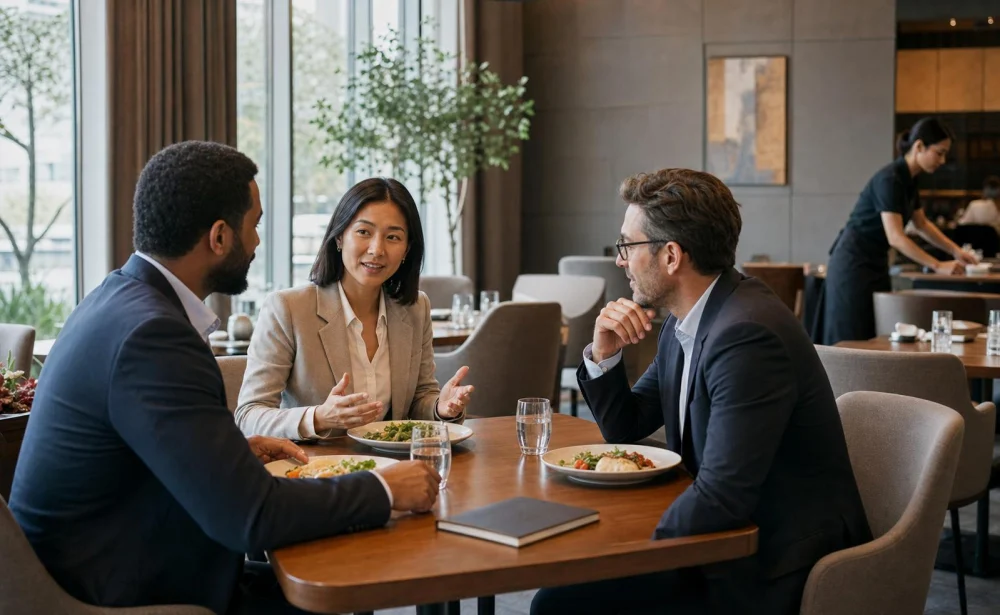
How to Choose a Restaurant for a Business Meal
In this guide
A strong business-meal restaurant does not need to be the most expensive or fashionable choice. It needs to make the meeting easy: convenient arrival, intelligible conversation, a menu everyone can navigate, predictable service, a manageable bill, and enough professionalism that logistics do not become the subject.

Quick answer
Choose a proven restaurant near all participants, review its current menu and prices, and call about noise, seating, access, dietary needs, service time, and receipt requirements. Reserve under a clear name with the full party count. Arrive early, confirm the table and payment plan, and keep a nearby backup. Favor reliable execution over a dramatic room, complicated menu, or destination that makes one guest travel much farther.
Match the setting to the purpose
A quick project check-in, recruiting conversation, client introduction, celebration, negotiation, and team dinner need different levels of formality and privacy. Define the objective before searching. If documents or detailed discussion are central, a short café table may be less useful than a quiet full-service lunch.
For a first meeting, choose a broadly comfortable format rather than a highly interactive concept that demands constant cooking, performance, or shared handling. For a celebration, energy and a larger table may matter more than quiet.
Do not conduct confidential, regulated, personnel, legal, or commercially sensitive discussions in a public dining room merely because a corner looks private. Move genuinely sensitive work to an appropriate secure setting.
Choose a fair and predictable location
Compare travel time, not just distance. Consider traffic direction, transit, parking, rideshare pickup, building access, weather exposure, and the guest's next appointment. A restaurant one mile away can be harder than one three miles away.
Verify the exact entrance and branch. Hotel restaurants, malls, office complexes, and venues may have several doors or parking systems. Send a map link and a concise landmark in the invitation.
If mobility access matters, ask about the route from sidewalk or parking to the table and restroom, not only whether the building is described as accessible. Elevators, steep routes, heavy doors, and temporary patio setups can change the experience.
Confirm conversation and privacy conditions
Photos rarely reveal acoustics. Call and ask when the room is quieter, whether music volume changes, and whether a side room, booth, or table away from the bar and kitchen pass exists. Explain that conversation matters; do not claim a disability unless it is true.
Hard surfaces, closely spaced tables, live music, open kitchens, and busy bars can make speech difficult. Lunch may be quieter than dinner, but popular business districts can have a loud noon rush.
A private dining room can improve control but may carry a minimum spend, deposit, fixed menu, service charge, audiovisual fee, cancellation policy, or time limit. Review the full written terms.
Check menu range and dietary needs
Review the current menu from the restaurant's official source. Look for several price points, foods that are easy to eat while talking, and enough variety that no guest must announce personal details to find a meal.
Ask participants privately about allergies, dietary practices, and strong preferences before booking. Then call the restaurant with specific needs. A menu symbol is useful but does not fully describe ingredients or cross-contact.
Avoid making the person with a restriction negotiate publicly at the table if it can be handled earlier. For a serious allergy, the guest's direct conversation with the restaurant may still be necessary.
Make a complete reservation
Use the host's recognizable name and correct phone number, date, time zone when travel is involved, party size, and accurate duration. Include assistants or colleagues who will sit at the table. Note access and seating requests without treating them as guaranteed.
Check deposit, cancellation, no-show, late-arrival, table-duration, minimum-spend, and complete-party policies. Put the reservation in a shared calendar with the address, host name, and contact number.
Confirm the day before for an important meal and update the restaurant promptly if attendance changes. A four-person table becoming eight is not a minor adjustment.
Request useful seating without demanding it
A round table supports group conversation; a quiet booth may suit two to four people; a long table can make discussion difficult at the ends. Ask for a table with comfortable sight lines and enough room for water, plates, and a small notebook.
Avoid the direct path to restrooms, kitchen doors, server stations, speakers, or cold exterior doors when possible. If a guest uses a mobility device or interpreter, tell the restaurant what space or orientation is needed.
Arrive early to inspect the assigned table. If it does not work, ask politely what alternatives exist. The host may have limited options during a full service.
Control the meal's timing
Tell the server at the beginning if the group has a firm end time. Ask which dishes fit that window and whether separate courses will delay the meal. Ordering promptly is more effective than announcing a deadline after the main course is late.
For a 60-minute lunch, choose a restaurant accustomed to business service and avoid dishes with long cooking times. Consider preselecting a limited menu for a large group, with allergy-safe alternatives confirmed in advance.
Invite guests with a buffer for arrival, but do not make them wait unnecessarily. The host should arrive first, check in, and be ready to welcome rather than text directions from the table.
Plan budget, payment, and receipts
Review menu prices, beverages, tax, service charges, gratuity policy, parking, room fees, and minimum spend. Follow the organization's expense, gift, anti-bribery, and alcohol policies. When participants represent different organizations or public entities, compliance rules can be especially important.
Decide discreetly who pays before the meal. The host can give a payment card to the server early and request an itemized receipt. If the bill must be split, ask whether the restaurant can do so rather than creating confusion at the end.
Never pressure a guest to accept an expensive meal or hide the value. When policy is unclear, a modest venue and separate checks may be safer.
Keep alcohol optional and appropriate
No guest should need to explain why they are not drinking. Offer nonalcoholic choices naturally and avoid making alcohol the centerpiece of the meeting. Lunch, recruiting, driving, health, religion, recovery, pregnancy, medication, policy, and personal preference can all influence the choice.
If alcohol is ordered, follow organizational rules, legal age requirements, and responsible limits. Plan safe transportation and never encourage someone to “keep up.” The business purpose and every person's comfort take priority over a bottle.
A venue with a strong beverage program should also have credible alcohol-free options beyond plain water.
Build a discreet backup plan
Identify another suitable restaurant nearby with compatible hours and menu. Keep its phone number and walking or driving route. A private event, kitchen equipment failure, weather closure, lost reservation, or unexpectedly loud room can defeat careful planning.
For a high-stakes meeting, visit the primary restaurant at the same day and time in advance. Observe parking, host flow, acoustics, table spacing, service pace, and mobile reception.
If a problem occurs, solve it calmly. Guests should hear, “I have another table five minutes away,” not a long argument with staff.
Frequently asked questions
Is a fine-dining restaurant best for business?
Not automatically. Reliability, location, sound, menu fit, timing, and policy compliance matter more than price or prestige.
Should I choose a new trendy restaurant?
Only if you have verified its operation. An established restaurant you know may be safer for an important meeting.
Who should choose the restaurant?
The organizer usually proposes options after checking guest needs. For an external guest, offering two suitable choices can be considerate.
Can we use laptops at the table?
Ask whether space, outlets, and venue policy permit it, but avoid exposing confidential screens or creating trip hazards. A meeting room may be more appropriate.
What if the guest arrives late?
Notify the host stand, check the table's grace period, and ask whether to order. Avoid creating pressure or public embarrassment.
Choose for reliable conversation
The right business restaurant quietly supports the work. Match it to the meeting's purpose, choose a fair location, verify acoustics and access, check the menu and restrictions, reserve accurately, plan timing and payment, and keep a backup. When those details disappear into the background, participants can focus on the conversation they came to have.


 Vegan Eats And Drinks - Fusion Restaurant4.0 (80 reviews)
 McDonald's3.0 (2590 reviews)
 Lytebite Chandler4.0 (60 reviews)
 Subway3.0 (514 reviews)
 Sushi MX4.0 (19 reviews)
 Wok A Holic3.0 (66 reviews)
 Highly Rated Mediterranean Restaurants in the US: Best Dining Guide
 Explore Family Friendly Restaurants in US Cities
 The Best Restaurant Dining Experiences for Weekend Food Adventures
 Real Reasons Why Local Restaurants Often Beat Chains: A Culinary Perspective
 Hidden Gems in San Francisco for Local Dining
 Local Favorites in Portland for Organic and Fresh Food Guide