
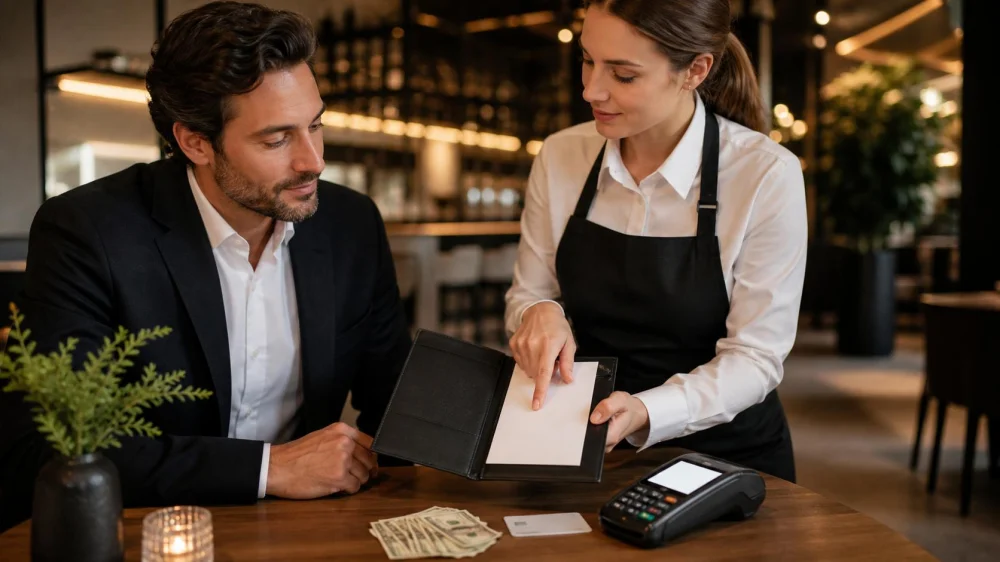
Restaurant Payment Policy: Confirm Cash, Cards, and Fees
On this page
- Quick answer
- Check before ordering
- Understand cash acceptance
- Confirm cards and mobile wallets
- Identify surcharges and discounts
- Account for deposits and holds
- Plan group payment
- Handle a declined payment calmly
- Review and save the receipt
- Resolve a payment problem
- Payment checklist
- Official consumer sources
- Conclusion and next steps
Quick answer
Before ordering, confirm whether the restaurant accepts cash, your card network, wallets, gift cards, or checks and whether it imposes a card surcharge, cash discount, minimum purchase, service charge, or deposit. Ask when the policy is not clearly posted. For groups, agree on one payment plan before the meal. At checkout, verify items, taxes, fees, service charges, tip, and total, then save an itemized receipt. Carry a lawful backup method without sharing PINs or sending money to an unfamiliar account.
Payment rules vary by jurisdiction, card network, restaurant, ordering channel, and event. Online listings can be outdated, so verify directly.
Check before ordering
Look at the entrance, menu, reservation terms, ordering page, and host stand for payment notices. Ask before becoming obligated for food or a cancellation fee.
Confirm whether dine-in, takeout, delivery, bar, catering, and private events follow different policies. A restaurant may accept a method in person but not online.
If only one method works for you, call ahead and record the date and answer. Bring a backup when practical.

Understand cash acceptance
The Federal Reserve explains that no federal law universally requires a private business to accept cash, although state or local law may require it. Restaurants may also restrict large bills or exact-change situations where permitted.
Ask whether cash is accepted at every register, whether a manager must handle large notes, and whether change is available. Do not wait until after the meal to reveal a payment constraint.
If a local cash-acceptance rule seems relevant, check the official government source rather than arguing from the words “legal tender.”
Confirm cards and mobile wallets
Card acceptance can vary by network, debit versus credit, physical card versus wallet, and domestic versus international issue. Ask about contactless payment and signature or PIN requirements.
Keep the card in sight where possible and inspect the terminal for damage or unusual attachments. Never tell staff a PIN or one-time bank code.
A digital wallet may protect the card number, but a dead phone, connectivity problem, or terminal failure can still interrupt payment.
Identify surcharges and discounts
Separate a credit-card surcharge from a cash discount, service charge, delivery fee, booking fee, or automatic gratuity. Each changes the bill differently.
Federal Regulation Z requires disclosure before a consumer becomes obligated when a finance charge is imposed for honoring a credit card, using restaurant dining as an example.
Ask whether the fee is a percentage or fixed amount, which card types it applies to, and whether tax and tip calculations include it.
Account for deposits and holds
Reservations and private events may require a deposit, card guarantee, or temporary authorization. Confirm when it is charged, refunded, released, or applied to the final bill.
Read cancellation, no-show, late-arrival, minimum-spend, and rescheduling terms before submitting payment information.
Temporary holds can reduce available credit or bank balance even when they later disappear. Ask the issuer about a hold that remains beyond the stated timeline.
Plan group payment
Ask whether the restaurant splits checks by seat, item, equal share, or a limited number of cards. Confirm before ordering, especially for large groups.
Choose one organizer to track shared dishes, drinks, tax, service charges, and tip. Avoid repeated person-to-person transfers at the server's station.
Do not pressure staff to exceed the restaurant's card limit after the meal. Use a group repayment method only with people and accounts you know.
Handle a declined payment calmly
A decline can result from security controls, limits, incorrect PIN, connectivity, account status, or terminal problems. It does not reveal the full reason to the restaurant.
Try a permitted backup method or contact the issuer using the number on the card or official app. Do not call a number supplied by an unexpected message.
If no method works, speak privately with a manager and follow a lawful documented resolution. Do not leave without agreement.
Review and save the receipt
Match the itemized bill to the order and check quantity, price, substitutions, discounts, taxes, surcharges, service charges, and deposit credits.
Determine whether gratuity is included before adding a tip. Keep customer and merchant copies separate and avoid leaving full card details on the table.
Save the final receipt until the transaction posts. Photograph it if thermal paper may fade.
Resolve a payment problem
Raise a bill error before leaving when possible and ask for a corrected itemized receipt. Keep names, dates, photos, and written communication.
For a duplicate, unauthorized, or incorrectly processed card charge, contact the restaurant and card issuer promptly under the issuer's dispute procedure.
Do not post sensitive card information publicly. Report suspected fraud through official bank, regulator, or law-enforcement channels.
Payment checklist
- Accepted cash, card networks, wallets, and gift cards confirmed
- Minimum purchase and backup method understood
- Card surcharge, cash discount, and service charge identified
- Deposit, hold, and cancellation terms saved
- Group split method agreed before ordering
- Itemized bill, tax, fees, gratuity, and total reviewed
- Final receipt retained until payment posts
Official consumer sources
The Federal Reserve answers whether a U.S. business may refuse cash and notes that state law can change the general federal position.
The Consumer Financial Protection Bureau's Regulation Z commentary discusses advance disclosure of a finance charge imposed when honoring a credit card and specifically gives a restaurant example.
Local law and the current restaurant policy still need direct verification.
Conclusion and next steps
Restaurant payment problems are easiest to prevent before the first order. Verify accepted methods and fees, understand deposits, plan group splits, and keep a backup. At checkout, distinguish service charges from tips and inspect the itemized total. Preserve the receipt and use official restaurant and issuer channels to correct errors quickly.





 Krazy Cajun Seafood & Hibachi-Phoenix4.0 (576 reviews)
 Southern Fried4.0 (193 reviews)
 Midwest Wings XL4.0 (132 reviews)
 Dona licha mexican kitchen3.0 (368 reviews)
 Yogi's Grill3.0 (485 reviews)
 Chaat House4.0 (30 reviews)
 Top 5 International Restaurants in Chicago You Should Explore
 Highly Rated Burger Spots Across America You Should Try
 Best Ramen in Chicago for an Authentic Japanese Experience
 Restaurant Coat Check Guide: Store Belongings Safely
 Popular Choices for Affordable Dinner Options
 A Guide to the Best Dim Sum Restaurants in New York City