
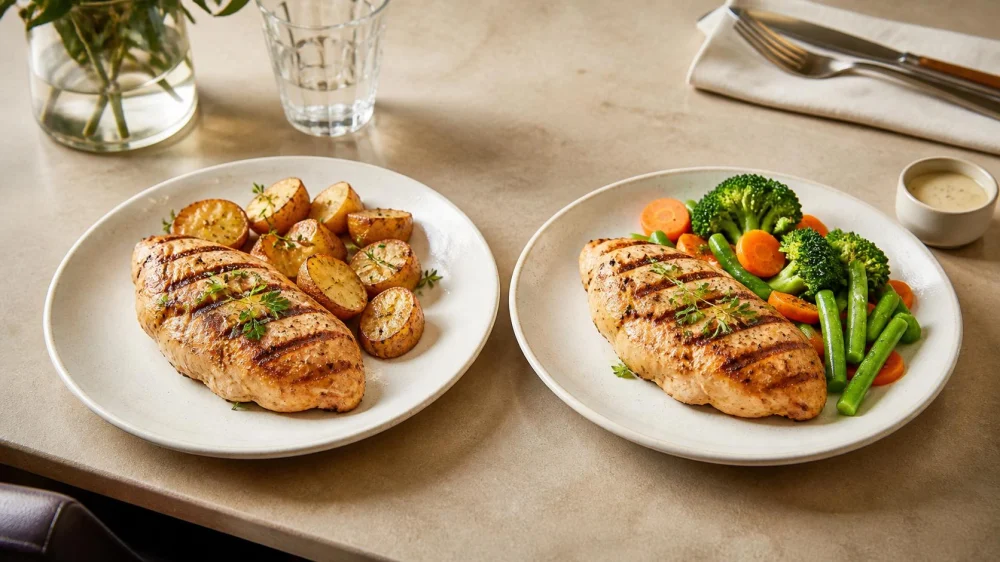
Restaurant Menu Substitutions: Ask What Can Change Before You Order
On this page
- Quick answer
- Name the reason for the request
- Ask about one component at a time
- Treat allergy requests differently
- Confirm price and portion changes
- Respect kitchen and service limits
- Check the plate when it arrives
- Verify takeout modifications
- Substitution checklist
- Important limitations
- Evidence notes
- FAQ
- Next steps
Quick answer
Before ordering, state the exact ingredient or component you want changed and ask what the kitchen can reliably do. Confirm whether the replacement changes the price, portion, cooking method, timing, or dietary status. A side swap, sauce omission, protein change, and allergen-control request are different tasks.
If the request involves a food allergy, say “allergy” clearly and name the allergen. Ask staff to check ingredients and cross-contact controls; if they cannot verify a safe option, choose another dish or restaurant rather than treating an ordinary substitution as a guarantee.

Name the reason for the request
Tell the server whether the change is a taste preference, vegetarian or religious practice, texture need, medical restriction, or diagnosed food allergy. This helps staff route the question appropriately without asking you to disclose more personal information than necessary.
Use specific language. “No dairy ingredients” is clearer than “light,” and “leave the garnish off” is different from “this guest has a sesame allergy.” Do not use “allergy” merely to strengthen a preference.
Ask about one component at a time
Break the dish into main item, sauce, seasoning, side, garnish, topping, and cooking method. Ask whether the component can be omitted, served separately, or replaced with an item already offered by the kitchen.
- Can the sauce be served on the side?
- Can the listed side be exchanged for another menu side?
- Is the protein pre-marinated or cooked to order?
- Is the garnish added at the pass or built into the dish?
- Will the change alter the cooking time?
A simpler request is often easier to execute accurately than redesigning the entire plate.
Treat allergy requests differently
Restaurant foods made after a customer orders may not carry the same packaged-food allergen label you see in a grocery store. Recipes, supplier products, shared fryers, grills, utensils, prep areas, and airborne powders can create ingredient uncertainty or cross-contact.
CDC research found gaps in restaurant allergy knowledge and notes that separate equipment or thoroughly cleaned and sanitized surfaces can reduce risk when feasible. Ask whether the restaurant has an allergy procedure, ingredient information, a manager or chef who can verify the request, and a way to mark the order.
If symptoms of an allergic reaction begin, stop eating and follow the person's emergency plan. Use epinephrine when prescribed and indicated, and seek emergency medical help; do not wait for the restaurant to identify the ingredient first.
Confirm price and portion changes
A substitute may be free, carry an upcharge, reduce the portion, or be unavailable. Replacing fries with a salad, changing a basic protein to a premium one, or adding extra vegetables can affect both price and serving size. Ask before the order is sent.
For a fixed-price menu, tasting menu, event, coupon, or meal package, substitutions may change eligibility or may not be offered. Get the revised total when cost matters.
Respect kitchen and service limits
Some dishes are batch-cooked, marinated, assembled in advance, or designed around a fixed sequence. A busy service, small kitchen, shared fryer, or limited ingredient supply may reduce what can change safely and consistently.
Ask early and accept a clear “no.” A restaurant that declines a modification it cannot execute may be giving more useful information than one that makes an uncertain promise.
Check the plate when it arrives
Before eating, compare the plate with the confirmed request. If the expected omission or replacement is not clear, pause and ask the server to verify it. For an allergy, do not simply scrape off the unwanted component because contact may already have occurred.
If the dish must be remade, confirm whether the kitchen will start with clean ingredients and appropriate equipment. Keep the conversation factual and focused on the agreed request.
Verify takeout modifications
Read the order summary before paying and check the printed or digital modification notes. At pickup, verify labels and containers without opening food in an unsafe area. Separate allergy meals from other packages when the restaurant provides a clear identifier.
If the item looks wrong, contact staff before leaving when practical. For delivery, photograph the label and dish, then use the platform or restaurant's support channel promptly.
Substitution checklist
- Name the exact ingredient or component.
- State whether it is preference, restriction, or allergy.
- Ask what can be omitted, separated, or replaced.
- For allergies, verify ingredients and cross-contact controls.
- Confirm upcharge, portion, and timing.
- Repeat the final order back.
- Check the plate or package before eating.
Important limitations
This is general U.S. dining guidance, not medical or legal advice and not an allergy-safety guarantee. Recipes, suppliers, staff training, equipment, local rules, and service conditions vary. People with food allergies should follow their clinician-approved avoidance and emergency plan.
Evidence notes
FDA identifies nine major U.S. food allergens and explains that packaged-food labeling requirements do not apply in the same way to food wrapped or boxed after a restaurant order. CDC restaurant research reports gaps in staff knowledge and supports ingredient information, training, allergy plans, and separate or thoroughly cleaned preparation equipment when feasible. These findings support direct, specific communication.
FAQ
Can any side dish be substituted?
No. Availability, preparation, package rules, and price vary by restaurant.
Should I say “allergy” for an intolerance?
Describe the restriction accurately and explain what must be avoided; follow clinician guidance.
Does removing a garnish make a dish allergen-free?
No. The ingredient or cross-contact may already be present elsewhere.
Can a shared fryer be part of the problem?
Yes. Ask whether other foods containing the allergen use the same oil and equipment.
Why does a substitution cost extra?
The replacement may have a different ingredient, portion, or labor cost.
What if the plate arrives wrong?
Do not eat it; ask staff to verify and remake or replace it as appropriate.
Next steps
Choose the dish closest to your needs, identify the one or two essential changes, and ask before ordering. Confirm ingredients, cross-contact, price, portion, and timing, then inspect the final plate or package.



 Ingo’s Tasty Food4.0 (669 reviews)
 Taco Bell3.0 (700 reviews)
 Anaya's Fresh Mexican Restaurant4.0 (422 reviews)
 In-N-Out Burger4.0 (3364 reviews)
 Filiberto's Mexican Food4.0 (1002 reviews)
 Federico's Mexican Food4.0 (310 reviews)
 Restaurant Outside Cake Policy: Confirm Before Celebrating
 Where to Find the Best Vegan Restaurants in New York City
 How to Find the Best Thai Food Restaurants in Your Area | Restaurants Explorer
 Why You Should Visit the Best Food Halls in Your City
 Where to Find the Best Vegan Breakfast in Portland
 How to Find the Best Japanese Restaurants in Your City | Top Tips for Finding Authentic Sushi & More