
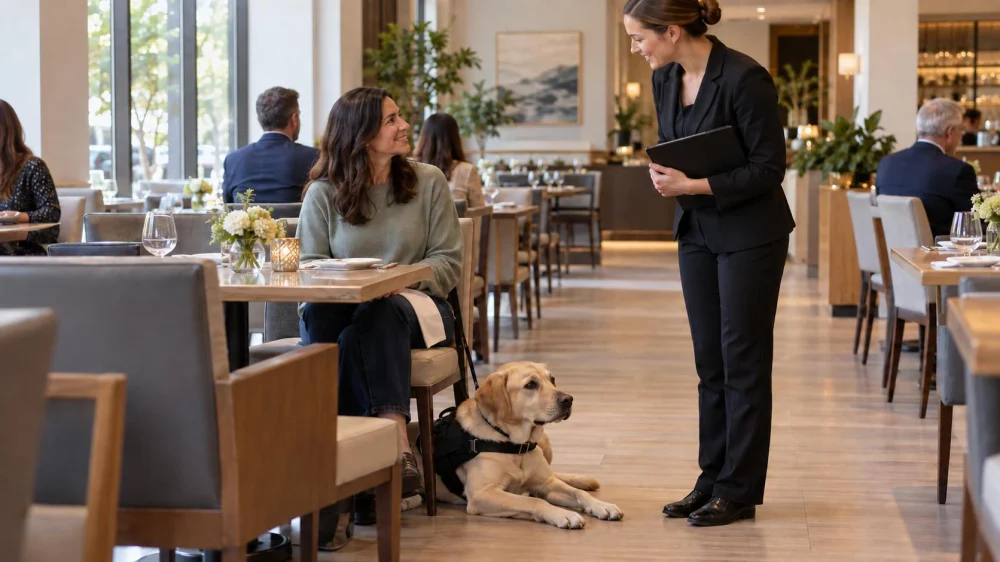
Restaurant Service Animal: Access, Seating, and Handler
On this page
Quick answer
Under the federal ADA, restaurants generally must allow a trained service dog to accompany its handler in areas open to customers, even with a no-pets policy. Staff may ask only two limited questions when the need is not obvious and may not demand certification. The handler remains responsible for control and care; the animal is not seated or fed at the table.

Plan before arrival
A handler is not required to call ahead, but an advance conversation can help with table clearance, route, and timing. Describe space needs without disclosing a diagnosis. Ask for a location that permits the animal to remain with the handler without blocking aisles.
Restaurant staff should brief the host and server, keep the reservation note factual, and avoid labeling the animal as a pet. A vest, tag, registry card, or professional-training certificate is not required by the ADA.
Know the permitted questions
When it is not obvious that a dog is a service animal, ADA guidance allows staff to ask only: “Is the dog a service animal required because of a disability?” and “What work or task has the dog been trained to perform?”
Staff may not request documentation, demand a task demonstration, or ask about the nature of the person's disability. When the answers establish ADA service-animal status, proceed with ordinary customer service.
Choose workable seating
Offer a table where the dog can stay on the floor near the handler without entering a server path. Do not isolate the party, impose a pet fee, or limit them to outdoor seating solely because of the service animal.
Chairs, plates, and table food are for customers. The ADA does not require a restaurant to seat or feed a service animal at the table. Staff are not required to provide animal care or supervision.
Maintain handler control
The handler is responsible for feeding, grooming, toileting, and supervision. The dog generally must be harnessed, leashed, or tethered unless that interferes with the animal's work or the person's disability prevents use; in those cases, control must be maintained through voice, signal, or another effective method.
Other diners should not pet, call, feed, photograph, or distract the animal. Address the handler, not the dog, when discussing space or service.
Address problems calmly
ADA guidance permits exclusion when a dog is out of control and the handler does not take effective action, or when the dog is not housebroken. A general fear, allergy concern, breed assumption, or another customer's objection does not automatically justify exclusion.
If exclusion is lawful, offer the person the opportunity to obtain goods or services without the animal present. Document observable conduct and the response, not guesses about disability.
Important legal limits
This article summarizes federal ADA guidance, not individualized legal advice. State and local laws may provide additional rights, and separate ADA rules address miniature horses. Direct policy questions to qualified counsel or the ADA Information Line, and address immediate threats through appropriate emergency procedures.
Frequently asked questions
Can staff require a service-animal ID card?
No. The ADA does not require certification, registration, a vest, or a special ID.
May the dog go through a self-service food line?
Yes. ADA guidance says service animals must be allowed to accompany handlers through self-service food lines.
Can the restaurant charge a pet fee?
No fee may be charged solely because of the service animal. Ordinary damage policies may apply on the same basis as to other customers.
Who gives the animal water?
The handler is responsible for care. The restaurant may choose to assist but is not required to supervise or care for the animal.
Sources and evidence notes
The U.S. Department of Justice provides an updated service animal overview and detailed service animal FAQs covering restaurants, questions, control, seating, feeding, fees, and exclusion.
Next steps
Handlers can request workable clearance; restaurants can train staff on the two questions and a respectful seating process. Consult current ADA and state guidance when a situation is unclear.





 Oregano's4.0 (2120 reviews)
 DARUMA Sushi/Roll/Noodle4.0 (573 reviews)
 Hodori4.0 (1119 reviews)
 Best Hong Kong Dining4.0 (543 reviews)
 Tara Thai 2go4.0 (85 reviews)
 Filiberto's Mexican Food3.0 (1131 reviews)
 Restaurant Live Music: Seating, Sound, Fees, and Exit
 Restaurant Service Animal: Access, Seating, and Handler
 Restaurant Texture Guide: Ask Before Choosing a Dish
 Restaurant Menu Specials: Ask What Changes Before Ordering
 Restaurant Condiment Service: Ingredients, Portions, and Sharing
 Restaurant Booth Seating: Space, Transfer, and Table Reach